We sell honey, so read this the way you would read anything written by someone with an interest. The test I set myself was that every section should still be useful if you go on to buy someone else's jar.
1. The flowers the bees worked
Honey is nectar, so it carries the character of whatever was flowering. Acacia is pale, mild and floral. Eucalyptus is stronger and slightly medicinal. Mustard sets thick and pale within weeks. Multifloral honey is whatever the season gave, and it changes from one harvest to the next.
This is the first thing to establish because everything downstream depends on it. Colour, aroma, how fast it crystallises, even the ratio of sugars in the jar all follow the flower. A honey is not better for being acacia or worse for being multifloral. It is only better or worse at being the thing it claims to be.
Which is why single origin is worth understanding rather than treating as a luxury word. It means the honey came from one floral source in one place in one season, so the description on the label can actually be checked. A blend averages several sources, often across regions and sometimes across countries, and averages are harder to verify and easier to adjust.

What to ask: which flower, which region, which harvest. A brand that knows its supply can answer all three in a sentence. A brand that buys on the open market usually cannot answer any of them.
2. How it was handled after the hive
Two things happen to honey between the frame and the jar, and both change it.
Heat. Warming honey makes it easier to filter and pour, and it delays crystallisation on the shelf. It also drives off aroma, reduces enzyme activity and raises a compound called HMF, which is the standard laboratory marker for honey that has been cooked or has sat too long. Gentle warming to move honey through a line is ordinary. Sustained high heat is a trade of character for convenience.
Filtration. Straining out wax and bee parts is basic hygiene and every honey gets some of it. Ultra fine filtration goes further and strips out the pollen, which makes the honey clear and slow to set. It also removes the one thing that would let a laboratory identify where the honey came from.
Raw and unheated honey keeps more of its aroma and its pollen. That is a genuine difference in what you taste. It is not a purity claim, and this is the point where a lot of honest writing about honey goes wrong: processed honey is not automatically fake honey. A filtered supermarket jar can be entirely genuine honey that has simply been standardised. Processing and adulteration are two different questions, and a honey worth paying for has to answer both.
3. Ignore the water test, the thumb test and the flame
The home tests circulate endlessly and none of them works. Whether honey sinks in a glass of water, holds its shape on a thumb or lights on a matchstick is mostly a function of how much water is in it. Thick adulterated honey passes. Genuine honey with slightly higher moisture fails.
Honey that sinks and holds together is pure
Measures viscosity, which follows moisture. Sugar syrup thickened correctly sinks exactly the same way.
Real honey lights a matchstick
Any low moisture sugar burns. A drier syrup lights more readily than a genuinely raw honey with higher water content.
Ants avoid real honey
Ants go to whatever is accessible and sweet. There is nothing here to read.
These are worth doing for fun and worth nothing as evidence. We wrote about them at more length in how to spot real honey, along with what you can reasonably judge by eye. The short version is that adulteration is a question about sugars at the molecular level, so it gets settled in a laboratory or not at all. If you want to judge a jar you already own, we wrote ten questions to run it through.
4. Laboratory testing, and what each test is for
This is where a claim either becomes checkable or stays decorative. A report is not one number. Different tests answer different questions, and knowing which is which lets you read a report instead of trusting a summary of it.
| Test | What it tells you |
|---|---|
| Moisture | How much water the honey holds. Above roughly 20 percent it can ferment. Low moisture usually means it was ripe when it came off the hive rather than taken early. |
| HMF | Hydroxymethylfurfural rises with heat and with age. A high figure means the honey was warmed hard, stored badly or is simply old. |
| Diastase activity | A natural enzyme that falls as honey is heated. Read alongside HMF, it is the clearest evidence of how gently a honey was handled. |
| Sugar profile | Fructose, glucose and sucrose. High sucrose points to bees fed on sugar or syrup added later. The fructose to glucose ratio also predicts how fast the honey will set. |
| C4 sugar, by SCIRA | Compares the carbon signature of the honey against its own protein. Cane sugar and corn syrup come from C4 plants and read differently from nectar, so this catches them. |
| Pollen analysis | Identifies the flowers the bees actually worked. This is the only test that supports a floral claim such as acacia, and the only one that speaks to geographic origin. |
| Heavy metals | Lead, cadmium and similar contamination picked up from the environment around the apiary. Matters more the closer the hives sit to industry or heavy traffic. |
| NMR profiling | A broad screen that compares the whole molecular fingerprint against a reference database. Catches a far wider range of syrups in one test. Expensive, and mostly run in Europe. |
The practical question is not whether a brand says it tests. Nearly all of them say it. The question is whether you can see the report, whether it names the harvest or batch you are being sold, and whether it comes from an accredited laboratory rather than an unnamed one.
5. What adulteration actually looks like now
The reason none of this can be settled by the label is that the sophisticated version of adulteration is built to survive the label. Nobody is stirring visible sugar into a jar. Syrups are engineered to match the sugar ratios of honey closely enough to pass the standard checks.
India learned this publicly in December 2020, when the Centre for Science and Environment sent thirteen branded honeys for testing. Almost all of them passed the Indian tests, including C4. Most of the same samples then failed NMR testing in Germany, which picked up rice syrup that the C4 method is not built to see.
The blind spot is chemical, not moral. C4 testing works by carbon signature. Cane and corn are C4 plants and stand out. Rice and beet are C3 plants and sit close enough to nectar that the test cannot separate them reliably.
So a clean C4 report is real evidence, and it is not the whole answer. A brand that understands its own report will tell you that. A brand that treats one clean line as proof of everything is telling you it has not read it.
We use C4 by SCIRA together with pollen analysis, and we say plainly what that does and does not cover. We compared which Indian brands actually publish anything at all in this audit, including the ones that run the more thorough NMR test.
6. Crystallisation tells you about the flower
Honey sets when glucose comes out of solution. Fructose is far more soluble and stays dissolved much longer. So the speed at which a honey turns solid is set by its sugar ratio, which is set by the flowers.
Mustard honey can granulate within weeks and is completely genuine. Acacia has an unusually high fructose to glucose ratio and stays pourable for a year or more, which is also completely genuine. Sugar syrup, meanwhile, can be made to do either.
The one thing crystallisation does tell you is whether a claim hangs together. A honey sold as acacia that sets solid in a month is worth a question. We went through the chemistry, along with why the same ratio gives acacia the lowest glycemic index of the common honeys, on a separate page.
7. Taste it like you would taste anything else
Honey in India is sold almost entirely as a health product, which is why nobody tells you what it should taste like. It is worth taking as seriously as you would a coffee or an olive oil, because taste is the one assessment you can make yourself.
- Aroma first. Warm the spoon in your hand and smell it before you taste. Good honey smells of flowers or fruit or wood. Flat honey smells only of sweet.
- Floral character. There should be something identifiable underneath the sugar. If every spoonful of every jar tastes the same, the flowers have been averaged out.
- Sweetness. Sweetness should arrive with something behind it rather than as a single flat note.
- Finish. Notice what remains after you swallow. Honey worth its price leaves an aftertaste that lasts and changes. Syrup heavy honey stops the moment the sweetness does.
- Colour. Follows the flower, not the quality. Pale is not refined and dark is not stronger, though a colour that does not match the floral claim is worth asking about.
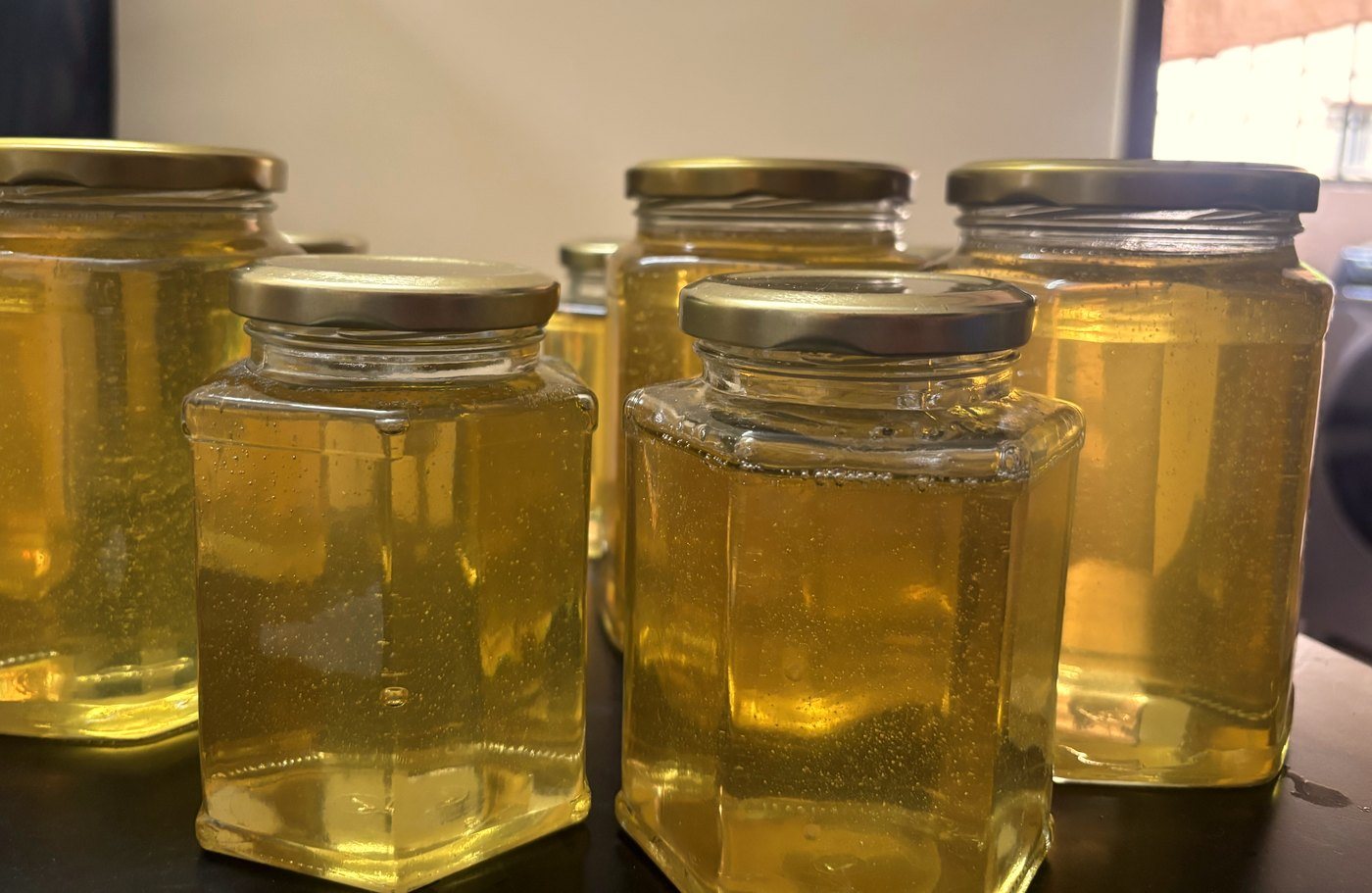
Kashmiri acacia is at the delicate end of this. It is pale, close to white gold, with a light floral aroma and a clean finish that does not linger heavily. It sweetens tea and kahwa without taking them over, which is what a stronger honey does. Whether you prefer that to a dark forest honey is genuinely a matter of taste, and anyone who tells you their end of the spectrum is objectively better is selling.
8. What we hold ourselves to
Having asked all of that, it is only fair to answer it.
| Question | Kashmir Reserve |
|---|---|
| Floral source | Acacia, from the blossom of the black locust, which flowers for a few weeks each year. |
| Origin | Single origin, Jammu and Kashmir. One region, one bloom, one harvest. |
| Blending | None. Nothing from other regions or seasons goes into the jar. |
| Processing | Raw and unheated. Acacia stays liquid on its own, so there is no reason to warm it. |
| Sourcing | Directly from beekeepers we deal with ourselves rather than through traders. |
| Testing | C4 by SCIRA and pollen analysis, at a NABL accredited laboratory, for each harvest. |
| The report | Until now we have sent it to anyone who asked. That is no longer good enough, so the full report for the 2026 harvest is going up on our lab reports page. If it says something we would rather it did not, we will publish that too. |
We have deliberately not claimed NMR. It is the broader test and we do not run it, so it would be dishonest to imply otherwise while we are asking you to check other people's claims.
The checklist
Before paying a premium for any honey, ours included, ask:
- Where is it from, specifically enough to point at on a map?
- Which flower does it claim, and does the colour and texture match that claim?
- Is it single origin or a blend of sources?
- Was it heated, and how finely was it filtered?
- Has it been tested at an accredited laboratory?
- Can I see the report, for the harvest I am buying, without asking?
- Does the brand tell me what its testing does not cover?
Seven questions, and a brand that can answer all of them has told you more than any word on the front of the jar. That is the standard we are trying to hold, and the reason we would rather be measured against it than against an adjective.
Single origin acacia honey from Jammu and Kashmir. Raw, unheated, tested each harvest.
See the honey →This page is general information about buying honey and not medical or dietary advice. Test descriptions are simplified for readers rather than written for laboratories. Nothing here is a statement about the quality or purity of any other company's product. The Centre for Science and Environment findings referred to above were published in December 2020 and describe the samples tested at that time.